Have you just tried putting it in your calendar?
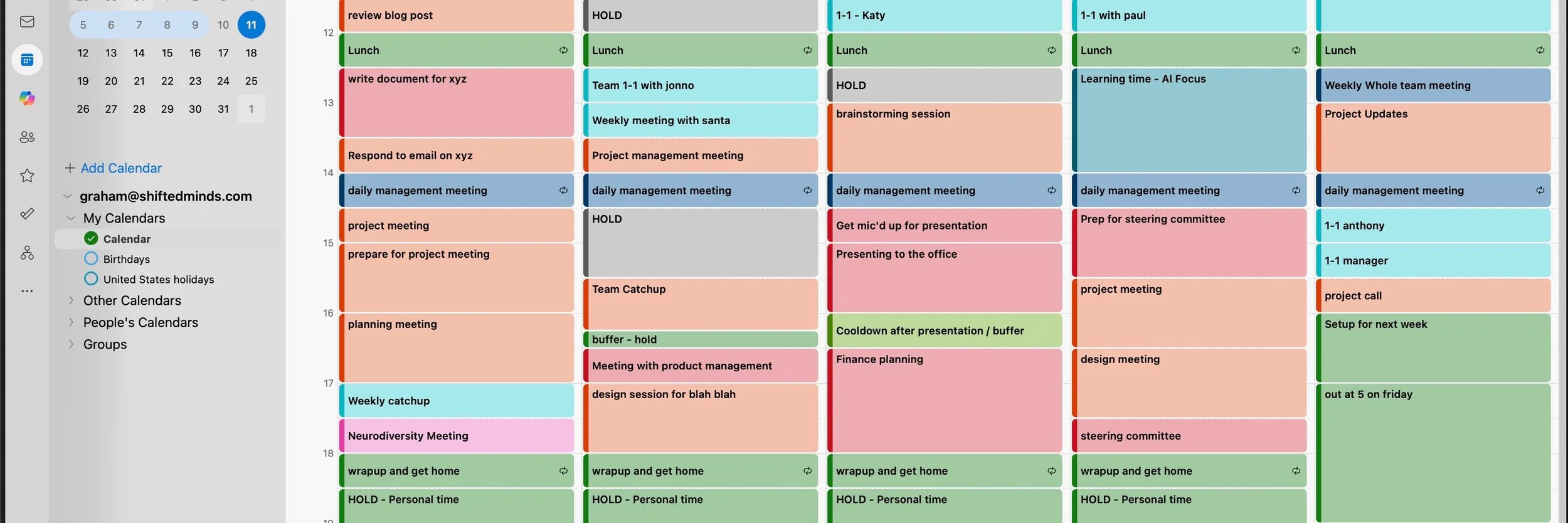
People love to say “Have you just tried putting it in your calendar?” as if the sentence itself is a solution. The tone is always the same. Calm. Reasonable. Gently corrective. As though the only thing standing between me and a functioning adult life is the act of clicking “add event” and choosing a colour. The implication is that the future is available to me in advance, neatly laid out and waiting to be managed. That time behaves politely. That it exerts a gentle, consistent pressure that responsible people respond to without drama. And that if something goes wrong, if I forget, double book, arrive late, or miss something entirely, the failure must lie in my effort rather than in the assumptions baked into the advice itself.
This piece is for people who suspect the problem was never putting things in the calendar, but being expected to experience time the way others do.
The truth is the problem starts long before the calendar. Most of the time, I do not even get as far as opening it. I think I will remember. I am in the middle of something else. Someone has just asked me for something. I am transitioning between tasks, between rooms, between modes of thinking. In that small gap between intention and action, the thought disappears. Not because it was unimportant, but because my brain does not reliably hold future intentions unless something external catches them. By the time I remember again, if I remember at all, the moment has often passed. The opportunity to capture it has gone, and the quiet sense of failure arrives instead.
This is usually described as time blindness, but that phrase can sound abstract. For me, it is concrete. Two months from now might as well be never. Time does not gradually approach or pull at my attention in the background. It does not feel like a line stretching forward. It exists in only two states. Now, and not now. Until something crosses that boundary, it has no emotional weight and no behavioural force. A calendar assumes that future events exert pressure in advance, that seeing them written down creates a felt sense of obligation. My brain does not work that way, and no amount of insight or intelligence has ever changed that.
For most of my career, calendars were not something I used. They were something other people used on me. I struggled to accept or decline meetings, so I left everything provisional, telling myself I might be able to make it if something else got cancelled. I rarely declined outright because the emotional cost felt too high. The fear of disappointing someone, of appearing difficult, outweighed the abstract cost of overload later in the week. I also did not reliably notice reminders, so even when things were booked, they did not regulate my behaviour in the way people assume calendars do. Meetings overran, stacked, and collided. I was constantly late, not because I did not care, but because the structure made punctuality impossible.
At one point, every weekday from early morning until late at night was booked. Some hours were four meetings deep. There was no lunch. No breathing space.Eighteen back to back thirty minute meetings in a single day was not unusual. My days became a live triage exercise, picking my way through in real time, choosing the most urgent meeting at each moment and disappointing everyone else. All my actual work happened outside working hours. Thinking, writing, designing, planning. During the day, my calendar was a battlefield, and I was simply reacting to whatever exploded next.
I was often the last person in the office after the lights had gone off. Once, after a system issue, I was still there at five in the morning when the cleaners arrived, without having been home. My personal calendar was empty, not because I had balance, but because I had no personal time left to record. When I did have time off, I was exhausted. I work for a US firm, which means my mornings are taken up with my work, regional leadership and office management, and my real workday does not begin until New York comes online in the afternoon. San Francisco follows later. My time is shaped by another country’s priorities, and I told myself this was just what senior roles were like. Everyone else seemed to cope. So this must be on me.
Deadlines did not approach gradually. They snapped into existence. When a hard deadline became imminent, everything suddenly became real. Adrenaline kicked in. My focus narrowed. I dropped everything else and worked until it was done. From the outside, this looked like thriving under pressure, like dedication, like leadership. From the inside, it was survival. Overworking was not ambition. It was compensation. It was how I made a brain that could not feel the future perform on demand. Burnout was not a surprise. It was the only remaining regulator once everything else had failed.
The change did not begin with rest or boundaries. It began with understanding. I realised something that sounds obvious once you say it out loud. If it is not in my calendar, I do not have time to do it. Not someday. Not theoretically. In reality. That was not an emotional breakthrough. It was an “ah, duh” moment. I finally understood the rules of the game I had been playing for years without knowing it. And once I understood the rules, I could start experimenting rather than blaming myself.
The first thing I changed was how the calendar looked. I stopped treating it as a passive record and started treating it as a model of reality. I colour coded everything. Every block had to belong to a small set of categories. Important. One to ones. Regional leadership. And categories that had never existed before. My work. Hold. Personal time. Nothing was allowed into the calendar unless it was categorised. At a glance, I could see proportion rather than detail. I could see how much of my week was being given away, and how little was left for thinking, recovery, or life. The colours told a story my words never had.
I also made a hard rule. No double booking. Ever. That rule forced decisions early, at the boundary, instead of under panic on the day. I had to accept or decline invitations as they arrived. I could no longer rely on last minute triage or hope that something else would fall away. This mattered more than I expected. It reduced the daily moral injury of disappointing people in real time. It also surfaced something uncomfortable. I had been using flexibility to avoid making decisions, and paying for it later with exhaustion and shame.
Even then, the calendar still did not work until I put my own basic needs in it. After starting ADHD medication, I stopped drinking coffee and diet coke. They had been my only sources of fluid. I realised, belatedly, that my brain works better when hydrated. So “fill up the water bottle” became a scheduled task. I drink a litre before lunch. I fill it again at lunch and drink through the afternoon. This is not wellness. It is cognitive infrastructure. I block time to eat lunch, because otherwise I will miss it. I block time for the gym and for walking meetings, because otherwise they will not happen. I schedule at least one walking meeting a day. I park further away and walk longer routes to and from the office as a decompression buffer between roles.
I shortened meetings to twenty five minutes where possible, because eighteen meetings a day was too much cognitive switching. My brain needed water breaks, bio breaks, and transition time. Once these things were visible and treated as real commitments rather than optional extras, thinking became easier. Time became slightly more navigable. The calendar stopped being a list of demands and started becoming a set of conditions under which my brain could function.
There was another lesson I learned much later, and more painfully, about downtime and recovery. For most of my adult life, being ill was not a reason to stop. It was an inconvenience to work around. I would keep going as long as I physically could, dialling into meetings, answering emails, pushing through with the same logic I applied to everything else. If I slowed down, things would pile up. So I compensated. The result was predictable. I would recover just enough to return to work, only to get sick again shortly afterwards. No one benefited from this. It took repeated cycles of burnout and illness to accept what should have been obvious. Rest is not time lost. It is time that prevents further loss.
The same realisation landed around travel and time off. I have always found travel dysregulating. The sensory load, the disruption to routine, the anticipatory anxiety, the cognitive effort of transitions. For years, I treated holidays as something you squeezed in between work commitments, finishing one day and leaving the next, returning late and going straight back into meetings. I now understand that this was never neutral for my nervous system. It was a tax I paid later in exhaustion, irritability, and reduced capacity. So I changed the rule. I take at least a day off before travelling, and at least a day after returning. Those days are not indulgent. They are buffers.Time for my nervous system to settle, reorient, and land. I have written this into my SOP so I do not have to renegotiate it with myself each time. The permission is already there.
What matters is not the specific rule, but what it represents. Downtime is not something that happens if there is space left over. It has to be made visible and non negotiable, just like meetings and deadlines. Otherwise it disappears. Once I treated recovery as part of the system rather than a reward for surviving it, my health improved and my work became more sustainable. Time off stopped being something I fell into when I collapsed, and started being something I planned for in advance. That shift alone has probably saved me years of cumulative damage.
The biggest shift came when I stopped relying on myself to organise future interactions at all. As I set up my coaching work, I automated scheduling. Forms capture details. Automations notice when they are filled. People are sent links to book time directly into my calendar. I no longer have to remember to arrange sessions. I no longer have to negotiate availability. The system handles it. What mattered was not the tools themselves, but that they removed remembering and negotiation from a system that had never handled them well. This forced my home calendar to become honest. If anyone could book time with me, my availability had to be real. Commutes, work hours, protected time. Everything had to be blocked out. I could see where my life was actually going, not where I told myself it was going.
This became a meta game changer. The calendar stopped being something I checked occasionally and became a shared object that other people interacted with. I even use this with friends now. Sending a link is easier than endless back and forth to organise a meet-up that collapses under complexity and never results in meeting. This is not laziness. It is accessibility. It is the removal of remembering and negotiation from a system that never handled them well in the first place.
What sits underneath all of this is the AuDHD paradox. My ADHD side needs flexibility, novelty, low friction, and interest. My autistic side needs predictability, calm, order, and reduced cognitive noise. Trying to satisfy both internally was exhausting. What finally worked was letting systems hold that tension for me. Rules instead of judgement. Visual proportion instead of vague busyness. Early decisions instead of last minute apologies. Automation instead of remembering. My body treated as part of the system rather than something to push through.
I no longer interpret overwork as commitment. I no longer expect myself to feel the future. I build scaffolding first, and only then do I ask myself to show up inside it. Calendars do not fail because they are badly used. They fail because they assume a brain that experiences time as continuous, negotiable, and emotionally real in advance. For some of us, that assumption was never true. When we stop trying to organise ourselves into a different person and start building around the brain we actually have, time stops being something we are constantly running from. It becomes something we can finally see.
If I were coaching someone on this, I would not start with calendars at all. I would start by getting curious about how time actually behaves for them, not how they think it should behave. I would want to know when time becomes real, what makes something tip from abstract into urgent, and what has to happen before action reliably follows intention. Most people have never been asked those questions. They have only been told that forgetting is a failure and remembering is a virtue. I would want to strip that framing away first, because as long as time is treated as a moral test, no system will ever feel safe enough to use.
I would be interested in where their calendar currently lives in their life. Whether it is something they consult, something they avoid, or something that other people use to make demands of them. I would want them to understand whether their calendar reflects reality, or whether it represents an aspirational version of themselves that they are constantly failing to live up to. Many neurodivergent adults carry calendars full of lies. Meetings they might attend. Time they might have. Energy they do not actually possess. The shame does not come from missing events. It comes from repeatedly being confronted with a version of themselves that does not exist.
I would also get them to pay close attention to what happens in the body. Whether hunger, dehydration, fatigue, or sensory overload are quietly sabotaging cognition long before anything reaches the calendar. Most people have been taught to treat these as secondary concerns, things to deal with once the real work is done. For many ADHD and autistic adults, they are the real work. If the body is dysregulated, time collapses. Everything becomes urgent, or nothing does. No amount of scheduling compensates for that. I would want to give explicit permission to put physiological needs into systems without apologising for them.
I would be especially careful around the question of boundaries. Many people assume that declining meetings or protecting time is a confidence issue, or a values issue. Often it is neither. It is an executive function issue combined with relational fear. Saying no early requires clarity, certainty, and the ability to tolerate discomfort in advance. Many people instead default to flexibility, hoping the future will sort itself out. Then they pay for that flexibility later with panic, overwork, and last minute disappointment. I would want to help someone see that early decisions are not selfish. They are kinder than late apologies.
I would also normalise the idea that remembering and negotiating are forms of labour, and that it is reasonable to remove them from the system entirely. Automation is not indulgence. It is accessibility. Letting other people book into your calendar is not antisocial. It is a way of making availability explicit instead of performative. Externalising time into shared systems forces honesty, and honesty is often what people have been missing rather than discipline.
Most importantly, I would help someone explore the tension between their need for structure and their need for freedom without framing it as a flaw. Many AuDHD adults believe they have to choose between spontaneity and order, between creativity and calm. In reality, the work is often about building systems that can hold that contradiction so the person does not have to. Systems should reduce internal conflict, not amplify it. They should absorb complexity, not demand constant self control.
I would want them to leave with a different question than the one they arrived with. Not “how do I manage my calendar better,” but “what kind of relationship with time actually supports the way my brain works.” Once that question shifts, calendars stop being something you fail at and start becoming something you design around yourself. That is where change tends to stick.
I write about these experiences because I spent years thinking I was broken, when what I actually needed was language for how my nervous system works.
I write one thoughtful piece a week for people who find themselves overwhelmed by things that everyone else seems to cope with. If this resonated, subscribing just means you’ll get the next one quietly, without pressure or expectation.
Subscribe quietly
If you know someone who’s struggling with the weight of something, sharing this might help them feel understood.
Mette C. (2023). Time Perception in Adult ADHD: Findings from a Decade-A Review. International journal of environmental research and public health, 20(4), 3098. https://doi.org/10.3390/ijerph20043098
Casassus, M., Poliakoff, E., Gowen, E., Poole, D., & Jones, L. A. (2019). Time perception and autistic spectrum condition: A systematic review. Autism research : official journal of the International Society for Autism Research, 12(10), 1440–1462. https://doi.org/10.1002/aur.2170
Kandice J. Benallie, Maryellen Brunson McClain, Kaelah E. Bakner, Tyus Roanhorse, Jennifer Ha, Executive functioning in children with ASD + ADHD and ASD + ID: A systematic review. Research in Autism Spectrum Disorders,,Volume 86, 2021, 101807, ISSN 1750-9467. https://doi.org/10.1016/j.rasd.2021.101807